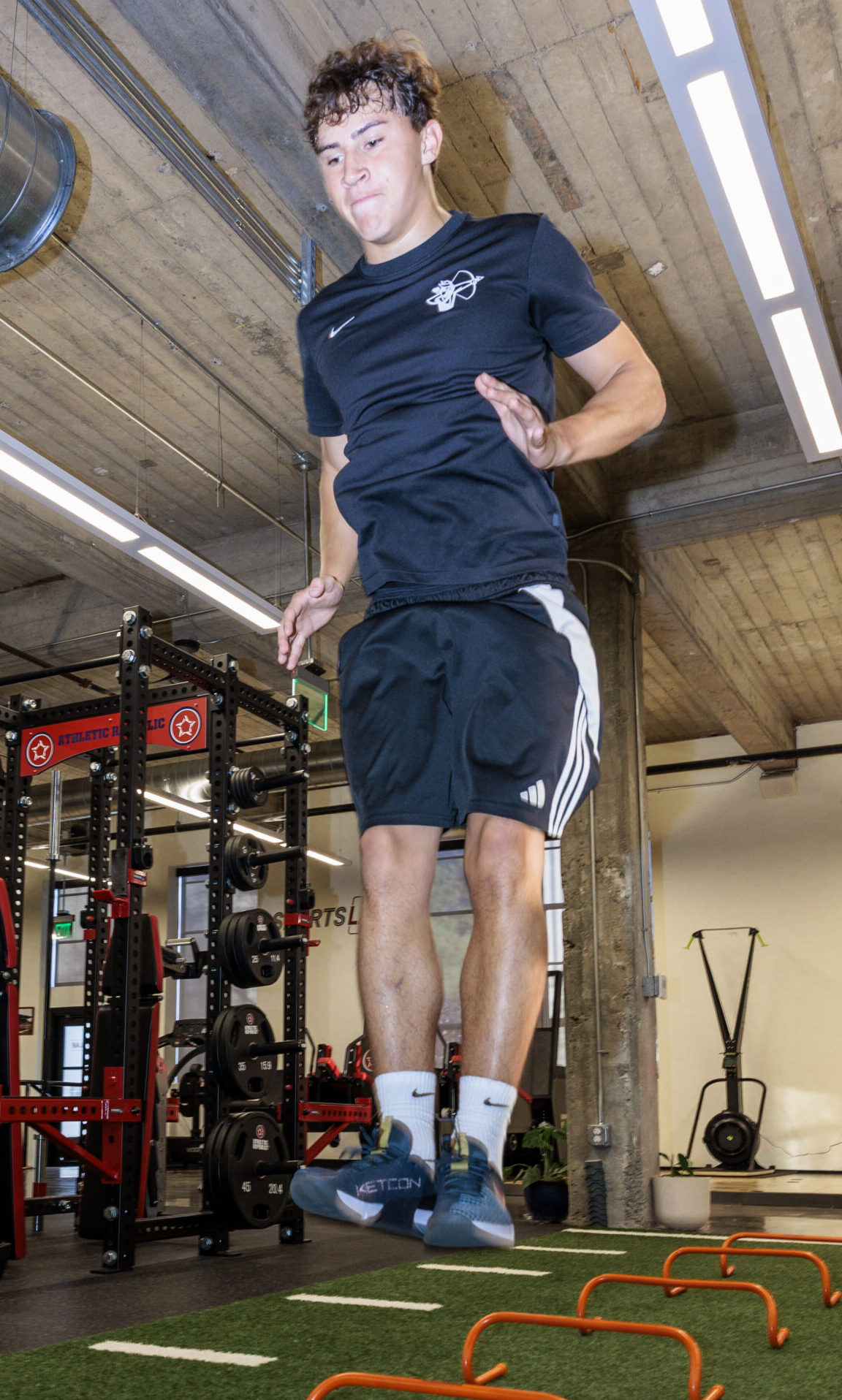
One of the most common questions I hear from parents is, "Is my child too young to start strength training?"
It's a fair question. Parents want their kids to become stronger, healthier, and more confident, but they also want to make sure they're not doing anything that could negatively affect their growth or development.
For years, parents have heard that lifting weights can stunt growth or increase injury risk.
But what does the research actually tell us?
When properly designed, supervised, and progressed, strength training is a safe and beneficial activity for children and adolescents. [1] [2]
The bigger question shouldn't be whether kids are old enough to lift weights. It should be how we're teaching them to move and preparing them for long-term development.
DOES STRENGTH TRAINING STUNT GROWTH?
Let's address one of the biggest misconceptions about youth strength training.
No, properly designed and supervised strength training has not been shown to stunt a child's growth. [1]
In fact, research supports several important benefits, including improved muscular strength, physical performance, and overall fitness. Developing muscular fitness is also associated with positive health outcomes, including bone health. [1] [2] [3]
Both the American Academy of Pediatrics (AAP) and National Strength and Conditioning Association (NSCA) support age-appropriate youth resistance training when properly coached and progressed. [1] [2]
The important distinction isn't simply how old a child is. It's whether they're learning appropriate movements, using suitable resistance, and progressing based on their abilities.
STRENGTH TRAINING STARTS WITH THE BODY
When parents picture strength training, they sometimes imagine heavy barbells and kids trying to lift as much weight as possible.
That's not where we start.
At Athletic Republic Portland, strength training begins with building a foundation.
Before worrying about how much weight a child can lift, we want to see how well they can move.
Can they squat with control? Maintain balance while lunging? Land from a jump? Slow themselves down and change direction?
We teach squatting, lunging, pushing, pulling, bracing, jumping, landing, and other fundamental movements.
Sometimes that involves resistance bands, medicine balls, or dumbbells. Other times, it involves nothing but body weight.
Weight training starts with the body.
Whether a child is nine years old or in high school, we meet them where they're at.
If they've never done something before, we teach them. If they've already developed competency, we find appropriate ways to challenge them.
Certain injuries or medical conditions may require additional considerations or evaluation by a healthcare professional.
Our job is to develop physical competency, not rush kids into exercises they're not ready for.
This approach is part of our broader training philosophy at Athletic Republic Portland. We focus on building a strong foundation before progressing athletes to more challenging exercises. Learn more about how we train at Athletic Republic Portland and why long-term development guides everything we do.
OUR PHILOSOPHY: YOU HAVE TO EARN THE WEIGHT
One of the biggest principles we follow is simple:
You have to earn the weight.
Let's use the squat as an example.
A younger athlete might begin with a bodyweight squat. We coach their positioning, make corrections, and sometimes use heel wedges to help them access a better position.
Once they consistently demonstrate good movement quality across multiple sets and workouts, we might introduce a light goblet squat.
As they improve, we gradually increase resistance. Eventually, when appropriate, they may begin learning barbell variations.
But progression isn't determined by age.
We may have an older athlete who's still developing competency with a goblet squat and a younger athlete who's ready to learn a barbell movement.
Both are perfectly fine.
And if their technique starts breaking down as we add resistance? We reduce the weight, coach the movement, and build back up.
Competency comes before load. Every time.
We're not chasing numbers. We're developing stronger, more capable movers.
STRENGTH TRAINING ISN'T JUST FOR ATHLETES
While strength training is often discussed in the context of sports performance, its benefits extend far beyond athletics.
Every child can benefit from developing strength, coordination, balance, and the ability to control their body.
You don't need to play competitive sports to benefit from learning how to squat, jump, land, carry, or move confidently.
These are fundamental human movements.
A systematic review found positive associations between muscular fitness and several health outcomes in children and adolescents, including bone health and metabolic health. [3]
For athletes, developing these physical qualities also creates a foundation for the sport-specific skills they learn during practice.
The weight room isn't where we teach basketball, baseball, or soccer skills. It's where we develop physical qualities that help athletes perform those skills.
We're not just developing better athletes. We're helping develop healthier, stronger, and more capable kids.
CAN STRENGTH TRAINING HELP REDUCE INJURY RISK?
Parents sometimes worry that strength training will increase their child's injury risk.
But well-designed strength and neuromuscular training can actually help reduce certain sports injuries.
A 2017 meta-analysis found an approximately 42% reduction in lower-extremity injury rates across the studied youth neuromuscular training programs. [4]
These programs included combinations of strength, balance, landing mechanics, and movement-control exercises. It doesn't mean weight training alone prevents every injury.
Think about what kids experience during sports: sprinting, jumping, landing, cutting, and repeatedly absorbing significant forces.
Good strength and conditioning helps prepare their bodies for those demands.
That's why avoiding appropriate strength training isn't automatically the safer option, especially when kids are already experiencing significant physical stress through sports.
HOW OFTEN SHOULD KIDS STRENGTH TRAIN?
Research-based recommendations from the AAP and NSCA generally suggest two to three strength training sessions per week on nonconsecutive days for youth. [1] [2]
But more isn't always better. Many kids already have busy schedules filled with practices, games, and tournaments.
Strength training should complement those activities, not simply add more physical stress.
Consistency, appropriate progression, and recovery are more important than cramming additional sessions into an already demanding schedule.
EVERY CHILD DEVELOPS AT THEIR OWN PACE
Here's something else I think is important for parents to understand.
Physical maturity can sometimes be mistaken for athletic ability or long-term potential.
We might see a 12-year-old who's significantly stronger, faster, or more powerful than their peers.
But part of that advantage may simply come from being physically more mature.
Research shows that biological maturation can influence physical performance during adolescence, especially strength and power. [5]
During puberty, changes in height, body mass, and limb length can also affect how athletes coordinate movement.
In my coaching experience, kids who have consistently practiced foundational movement skills often seem better prepared to navigate those changes.
That's a coaching observation, not something research has definitively proven.
What matters is understanding that two kids of the same age can be at very different stages of development.
We should be developing kids based on where they are, not comparing them to someone who may simply be further along physically.
BUILDING CONFIDENCE BEYOND THE WEIGHT ROOM
One of my favorite parts of coaching younger athletes is watching their confidence grow.
Some kids come in nervous, unsure of themselves, or worried about doing something wrong.
Then they learn a movement, improve their balance, get stronger, or accomplish something they couldn't do a few weeks earlier.
And you see that moment when they realize:
"I can do this."
A systematic review found that youth resistance training can improve certain measures of confidence in training ability and self-worth. [6]
I also believe there's something powerful about training alongside peers of a similar age.
Kids encourage one another, celebrate progress, build friendships, and realize they're not the only ones learning.
That sense of belonging is something we work hard to create at Athletic Republic Portland.
Because training shouldn't just develop physical abilities. It should help kids become more confident in themselves.
MOST IMPORTANTLY, KIDS SHOULD HAVE FUN
Here's something that can get lost in today's youth sports environment.
These are kids. This isn't their job, and it isn't their career.
Yes, we want them to become stronger, faster, and more coordinated. We want them to develop the physical qualities that support their sports and activities.
But we also want them to have fun.
We want them laughing, making friends, challenging themselves, learning new skills, and celebrating their progress.
Training should be something they look forward to, not another obligation on an already overwhelming schedule.
Whether a child dreams of playing college sports, enjoys recreational activities, or never plays organized sports at all, developing strength and learning how to move has value.
We're not just thinking about their next season.
We're thinking about the next 10, 20, 30, or even 50 years.
If we can help children build strength, confidence, and a positive relationship with exercise when they're young, we're giving them a foundation they can carry throughout their lives.
The goal isn't to develop the strongest 10-year-old. It's to help develop a healthier, more capable, and more confident person who enjoys being active for a lifetime.
That's what long-term athletic development means to us.
And that's what we're working toward every day at Athletic Republic Portland.
Move Better Longer.
READY TO GET STARTED?
Not sure whether your child is ready for strength and performance training?
At Athletic Republic Portland, our Youth/Middle School Acceleration program is designed for kids ages 9 and up. We meet each child where they're at and help them build foundational strength, speed, coordination, and confidence in a supportive environment.
REFERENCES
- Stricker, P. R., et al. (2020). Resistance Training for Children and Adolescents. Pediatrics. American Academy of Pediatrics. Read research
- Faigenbaum, A. D., et al. (2009). Youth Resistance Training: Updated Position Statement Paper From the National Strength and Conditioning Association. Journal of Strength and Conditioning Research. Read research
- Smith, J. J., et al. (2014). The Health Benefits of Muscular Fitness for Children and Adolescents: A Systematic Review and Meta-Analysis. Sports Medicine. Read research
- Steib, S., et al. (2017). Dose-Response Relationship of Neuromuscular Training for Injury Prevention in Youth Athletes: A Meta-Analysis. Frontiers in Physiology. Read research
- Malina, R. M., et al. (2015). Biological Maturation of Youth Athletes: Assessment and Implications. British Journal of Sports Medicine. Read research
- Collins, H., et al. (2019). The Effect of Resistance Training Interventions on 'The Self' in Youth: A Systematic Review and Meta-Analysis. Sports Medicine - Open. Read research