
Active Aging: Building Strength, Confidence, and Independence at Any Age
Getting older is inevitable. Becoming weaker, less capable, and less active doesn't have to be.
As we get older, it's pretty common to hear that we should start slowing down. Maybe we shouldn't lift heavy weights anymore, certain exercises are too risky, or we should just accept that we can't do the things we used to.
But does getting older really mean we need to stop challenging ourselves?
At Athletic Republic Portland, we don't believe it does.
Whether you're 15, 45, or 75, your body still benefits from movement, strength training, and being physically active. Sure, the exercises might look different depending on your abilities, experience, or health. But the overall goal doesn't really change.
We want to help people continue getting stronger, moving better, and doing the things they enjoy for as long as possible.
That's what active aging is all about.
Age Is a Number, Not a Limitation
One of the biggest misconceptions about getting older is that your age automatically determines what you should or shouldn't be doing in the gym.
You've probably heard things like, "I'm too old to lift heavy," or "I shouldn't be doing that exercise at my age."
But here's the thing: just because two people are the same age doesn't mean they have the same physical abilities.
Think about two people who are both 70 years old.
One has spent years strength training, hiking, and staying active. The other hasn't exercised consistently in decades.
Would we expect them to have the same strength, balance, or mobility? Probably not.
And we certainly wouldn't expect them to follow exactly the same exercise program.
This is actually the same philosophy we use when training younger athletes.
Just because a kid is 12 years old doesn't automatically mean they're ready for a particular exercise. And just because someone is 70 doesn't mean they aren't capable of performing that same movement.
We look at the person in front of us, assess their abilities, and figure out the best place to start.
That's where exercise progressions and regressions come in.
Someone might start by simply sitting down and standing up from a bench. As they get stronger, we might introduce a goblet squat, increase the resistance, or progress to another squat variation.
Everyone has a starting point, and everyone has an opportunity to improve.
Your age doesn't tell us what you're capable of. Your abilities help us determine where to start.
Why Getting Stronger Matters as We Age
Here's something we all need to understand about getting older: our bodies are going to change. That's part of life.
We naturally experience changes in muscle mass, strength, and physical function as we age. But that doesn't mean we should sit back and accept that we're just going to get weaker every year.
Research from the National Strength and Conditioning Association (NSCA) shows that resistance training can help older adults improve strength, preserve muscle mass, and maintain physical function and independence [1].
And when you think about it, strength is involved in almost everything we do.
Carrying groceries into the house. Picking up something heavy in the yard. Getting up off the floor. Walking up a flight of stairs. Playing with your grandchildren.
These might seem like pretty simple activities, but they all require some level of physical strength.
As we lose strength, those everyday tasks can start becoming harder than they need to be.
Building strength helps create a greater reserve of physical capacity, so everyday activities don't feel like they're pushing us to our limits.
That reserve is important whether you're carrying a heavy bag of groceries or enjoying a long afternoon of gardening.
The stronger and more capable we become, the better prepared we can be for the physical demands of everyday life.
Stronger Muscles, Healthier Bones, and a Healthier Heart
Strength training does a lot more than help us build muscle.
When we combine resistance training with regular physical activity, we're supporting several different systems that help keep our bodies healthy as we age.
Let's Talk About Bone Health
Our bones need physical stress to stay strong.
Just like muscles adapt to exercise, our bones respond to the forces we place on them.
As we get older, maintaining bone density becomes especially important because age-related bone loss can increase the risk of fractures.
The good news is that resistance training and appropriate weight-bearing exercise can help support bone health.
A 2022 systematic review found that progressive resistance training improved lower-body strength and hip bone mineral density in older adults, although improvements in bone density were less consistent than improvements in muscular strength [2].
That doesn't mean strength training completely eliminates the risk of osteoporosis or fractures.
But it does mean we're giving our bodies an opportunity to maintain and, in some cases, improve an important part of our physical health.
Don't Forget About Your Heart
Strength is important, but it's only one part of staying healthy and active.
We also want to make sure our cardiovascular system can keep up with the things we enjoy doing.
Think about taking a long walk, hiking, cycling, or spending an afternoon exploring a new city while traveling.
Those activities require endurance.
Regular aerobic exercise supports cardiovascular health and helps improve our ability to sustain physical activity.
The Centers for Disease Control and Prevention recommends that adults 65 and older get at least 150 minutes of moderate-intensity aerobic activity each week, along with muscle-strengthening activities at least two days per week and regular balance training [3].
That's why we don't believe in treating strength training and cardiovascular exercise as competing priorities.
They work together to build a stronger foundation for long-term health and physical independence.
Fall Prevention: Building a Body That Can Respond
Let's talk about something that becomes increasingly important as we age: falling.
Falls are a serious concern for older adults, and for good reason. They can lead to injuries, reduced confidence, and in some cases, a significant loss of independence.
But what can we actually do about it?
A lot more than people might think.
Balance training is important, but preventing falls isn't just about standing on one leg.
Think about what happens when you trip on an uneven sidewalk.
Your body has to recognize what's happening, react quickly, produce force, and regain control before you hit the ground.
That requires strength, power, balance, and coordination working together.
Research supports training these qualities. A large Cochrane review found that exercise programs, particularly those involving balance and functional movements, can reduce the rate of falls among older adults living in the community [4].
That's why we want to expose people to different types of movements and physical challenges rather than limiting training to just a few basic exercises.
But there's another part of this conversation that I think is equally important.
What happens if you do fall?
We can't prevent every fall, and no training program can guarantee that someone won't get injured.
However, maintaining muscle strength, bone health, and the ability to control your body can help build greater overall physical resilience.
The idea is to develop a body that's better prepared to handle life's unexpected challenges.
Because sometimes it's not just about avoiding a fall. It's also about having the physical capacity to respond when something doesn't go as planned.
Strength, Power, Balance, Mobility: We Want to Train It All
When it comes to active aging, we don't believe in focusing on just one aspect of fitness.
A well-rounded training program should address several physical qualities because everyday life demands more than just strength or endurance alone.
Strength: Being able to carry groceries, lift something off the floor, climb stairs, or get out of a chair without struggling.
Power: Being able to produce force quickly, whether that's reacting to a stumble, changing direction, or standing up quickly.
Balance and coordination: Being able to control your body while walking on uneven ground, stepping over obstacles, or moving through your environment.
Mobility: Having the freedom to move comfortably through the ranges of motion needed for daily activities, hobbies, and recreational sports.
Cardiovascular endurance: Having enough stamina to go for a long walk, hike, bike ride, or spend the day being active without becoming overly fatigued.
These qualities don't work independently. They overlap and complement one another.
For example, getting up from a chair involves strength, but doing it quickly also requires power. Walking on uneven terrain requires balance and coordination, while covering a longer distance challenges cardiovascular endurance.
Research supports appropriately designed resistance training for improving both muscular strength and power in older adults [1].
So how do we train those qualities?
For one person, developing power might involve standing up from a chair quickly while maintaining control. For another, it could involve medicine ball throws or more advanced movements.
Balance training might start with supported exercises before progressing to more challenging tasks.
The key is matching the exercises to the person's current abilities and gradually increasing the challenge.
Different starting points. Different exercises. Same goal: continuing to improve physical capacity.
Yes, Older Adults Can Lift Heavy Weights
This is probably one of the biggest misconceptions we hear about strength training.
Some people worry that lifting heavy weights is dangerous as they get older. Others are concerned they're going to get too muscular or bulky.
But lifting weights doesn't automatically mean you're going to look like a bodybuilder.
And lifting heavier weights isn't automatically dangerous just because someone is older.
What matters is choosing appropriate exercises, using good technique, managing training loads, and progressing based on individual ability.
The NSCA's position statement supports progressive resistance training as a way to improve strength, function, and quality of life in older adults [1].
And remember, heavy is relative.
A 15-pound dumbbell might be challenging for one person, while another might comfortably lift significantly more.
There's nothing wrong with either starting point.
What we care about is providing an appropriate challenge that gives the body a reason to adapt.
That doesn't mean every workout needs to be extremely difficult.
It means training should be purposeful.
And when someone's abilities improve, their program should have the opportunity to progress with them.
It's Never Too Late to Make Progress
One of the things I love about strength training is that there's almost always an opportunity to improve something.
And those improvements don't always have to be big.
Maybe you're able to do a few more repetitions than last month.
Maybe you're lifting five more pounds.
Maybe your balance has improved enough that you're more comfortable walking on uneven ground.
Or maybe you finally feel confident getting down on the floor to play with your grandchildren because you know you can get back up.
Those are all wins.
And they matter.
Research shows that older adults can make meaningful improvements in strength and physical function through appropriately designed resistance training [1].
Now, progress isn't always going to be linear.
There will be days when you feel great and days when you don't. That's true for athletes of every age.
We want to challenge people, but we also need to recognize that recovery, health, training experience, and individual circumstances all affect how someone should train.
The goal isn't to push harder every single day.
It's to continue making progress over time, whether that's through greater strength, improved movement quality, better endurance, or increased confidence.
And most importantly, we don't want people to feel like their opportunity to improve has passed them by.
The Benefits Go Beyond the Gym
We've talked a lot about strength, balance, bone health, and physical function.
But there's another side of active aging that I think is just as important.
Confidence.
When people feel strong and capable, it can change how they approach everyday life.
Maybe they're more comfortable going on a hike, trying a new activity, or traveling somewhere that requires more walking.
Maybe they feel more confident keeping up with their grandchildren.
Or maybe they simply enjoy knowing that their bodies are capable of more than they thought.
There's also something valuable about being around other people who are working toward similar goals.
Having a group to train with creates opportunities for connection, encouragement, and accountability.
And sometimes that social aspect is what helps people build a routine they actually enjoy.
Research on resistance training in older adults also recognizes improvements in psychological well-being and quality of life as important potential benefits [1].
Because at the end of the day, this isn't just about how much weight someone can lift.
It's about helping people feel capable, confident, and connected while continuing to enjoy life.
Our Approach to Active Aging at Athletic Republic Portland
At Athletic Republic Portland, our approach starts with understanding the individual.
We want to know what someone enjoys doing, what physical challenges they're experiencing, and what they'd like to improve.
From there, we can identify an appropriate starting point and develop a training plan that makes sense for their abilities.
For someone who's new to strength training, we might begin by teaching foundational movements, building comfort with resistance exercises, and gradually introducing balance and coordination challenges.
For someone who's already active, we might focus on developing additional strength and power, improving movement quality, or preparing for specific recreational activities.
Throughout the process, our coaches can adjust exercises, resistance, and complexity based on how each person responds.
We want training to be challenging enough to create progress while still being appropriate for the individual.
And as we expand our adult training opportunities at Athletic Republic Portland, we're excited to bring that approach to our Active Aging classes.
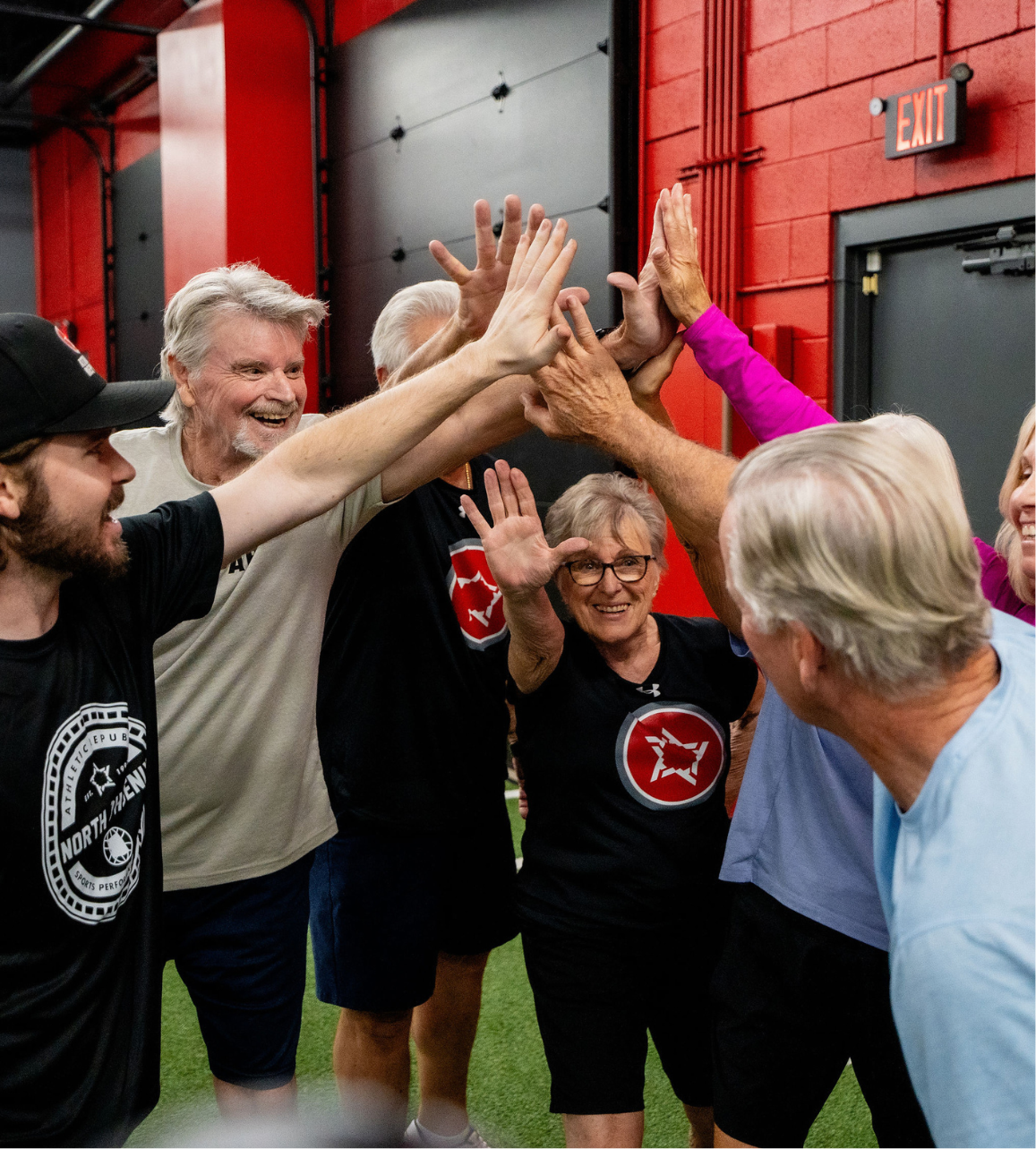
Our goal is to create an environment where adults can challenge themselves, learn new skills, build confidence, and enjoy training alongside others.
Whether you want to stay competitive in recreational sports, keep hiking your favorite trails, or simply make everyday activities feel easier, we want to help you keep moving forward.
Move Better Longer
Aging is a natural part of life.
But becoming less active, less confident, or less physically capable doesn't have to be something we simply accept without a fight.
By continuing to challenge our strength, power, balance, mobility, and cardiovascular fitness, we can help build the physical foundation needed to maintain independence and enjoy the activities that matter most.
The goal isn't to train like you're 25.
It's to train appropriately for who you are today while continuing to work toward who you want to be tomorrow.
Because getting older shouldn't mean giving up the things you love doing.
At Athletic Republic Portland, that's what we mean when we say:
Move Better Longer.
Ready to Start Your Active Aging Journey?
Whether you're new to strength training or have been exercising for years, our coaches can help you find the right starting point and continue progressing.
Explore our Active Aging membership options and class passes to find the training option that works best for you.
Online membership and class-pass link coming soon.
Phone: 503-542-2744
Email: portland@athleticrepublicteam.com
Website: portland.athleticrepublic.com
References
- Fragala, M. S., et al. (2019). Resistance Training for Older Adults: Position Statement From the National Strength and Conditioning Association . Journal of Strength and Conditioning Research, 33(8), 2019–2052.
- O'Bryan, S. J., et al. (2022). Progressive Resistance Training for Concomitant Increases in Muscle Strength and Bone Mineral Density in Older Adults: A Systematic Review and Meta-Analysis . Sports Medicine, 52, 1939–1960.
- Centers for Disease Control and Prevention. (2025). Older Adult Activity: An Overview .
- Sherrington, C., et al. (2019). Exercise for Preventing Falls in Older People Living in the Community . Cochrane Database of Systematic Reviews.


